
The Republic of Sabah North Borneo Government-in-Exile (RSNB-GiE) takes note of the statement issued by Malaysia's Ministry of Foreign Affairs on 21 September 2025, in which the Malaysian Government reaffirmed its commitment to peace, justice, freedom, human rights, opposition to colonialism and adherence to international law in defending the rights of the Palestinian people.
RSNB-GiE welcomes Malaysia's continued support for the Palestinian people's right to self-determination, freedom and independence. These principles represent fundamental values recognised within the international community and reflected in the Charter of the United Nations.
However, RSNB-GiE considers that Malaysia's public commitment to these principles raises important questions concerning their consistent application to the historical circumstances surrounding the incorporation of North Borneo, now Sabah, and Sarawak into Malaysia in 1963.
While the historical and legal circumstances of Palestine and Sabah are not identical, the principles of justice, human rights and self-determination must be approached with consistency and respect for the rights and aspirations of all peoples.
RSNB-GiE therefore calls upon the Malaysian Government, under Prime Minister Anwar Ibrahim's leadership, to acknowledge the legitimate historical questions surrounding the formation of Malaysia and to engage constructively with those seeking an independent examination of Sabah's decolonisation process.
The constitutional arrangements surrounding the establishment of Malaysia on 16 September 1963 deserve particular attention because they are central to understanding the political and legal status of North Borneo and Sarawak during the transition from British colonial administration.
The Malaysia Agreement 1963 (MA63), signed in London on 9 July 1963, identified the United Kingdom, the Federation of Malaya, North Borneo, Sarawak and Singapore as its parties. Article I expressly provided for the colonies of North Borneo and Sarawak, together with Singapore, to federate with the existing states of the Federation of Malaya, after which the Federation would be called Malaysia.
This constitutional arrangement was also reflected in the British Malaysia Act 1963, enacted on 31 July 1963. Section 1(1) provided for North Borneo, Sarawak and Singapore to federate with the existing states of the Federation of Malaya, with the resulting federation thereafter bearing the name Malaysia.
The United Nations' official membership record provides further confirmation of institutional continuity. It records that the Federation of Malaya became a member of the United Nations on 17 September 1957 and that its name was changed to Malaysia on 16 September 1963 following the admission of Singapore, North Borneo and Sarawak into the enlarged federation.
Contemporary Australian diplomatic correspondence also supports this historical understanding. In a cablegram dated 19 September 1963, the Australian Government addressed Malaysia's continued membership of the United Nations on the basis of the existing member state's change of name and territorial extension.
Taken together, these primary records provide substantial evidence that Malaysia's formation involved the constitutional enlargement and renaming of the existing Federation of Malaya, rather than the establishment of an entirely new international legal personality independent of Malaya's previous existence.
RSNB-GiE maintains that this distinction is historically and constitutionally significant. It challenges simplified accounts of Malaysia's formation that do not adequately explain the legal relationship between the pre-existing Federation of Malaya and the territories incorporated in 1963.
At the same time, RSNB-GiE recognises that constitutional continuity does not, by itself, conclusively determine whether the incorporation of North Borneo and Sarawak complied with every applicable requirement of international law. The question of legal continuity must therefore be distinguished from the separate and fundamental question of whether the peoples concerned were afforded an adequate exercise of self-determination.
It is this latter question that RSNB-GiE considers to require renewed and independent historical and legal examination.
The right of peoples to self-determination occupies a central position within the Charter of the United Nations and the international framework developed during the period of decolonisation.
United Nations General Assembly Resolution 1514 (XV), adopted on 14 December 1960, proclaimed the right of all peoples to self-determination and called for the ending of colonialism.
Resolution 1541 (XV), adopted on 15 December 1960, further articulated principles concerning the attainment of a full measure of self-government by Non-Self-Governing Territories. Its annex recognised independence, free association and integration as possible political outcomes, subject to their respective requirements.
In particular, Principle IX addressed integration with an independent state and emphasised that integration should reflect the freely expressed wishes of the territory's people, acting with full knowledge of the proposed change in political status through informed and democratic processes, impartially conducted and based on universal adult suffrage.
RSNB-GiE maintains that these principles provide an important framework for examining the process through which North Borneo and Sarawak were incorporated into Malaysia in 1963.
When MA63 was signed on 9 July 1963, North Borneo remained under British colonial administration. Its constitutional and representative institutions were still undergoing transition, and its people had not yet directly elected a State Legislative Assembly through territory-wide elections.
Indeed, the first direct election to the Sabah State Legislative Assembly was not conducted until April 1967, nearly four years after Malaysia's establishment. This historical fact is confirmed by the Malaysian Election Commission's reporting to Parliament.
Although electoral and consultative processes took place before September 1963, the absence of a directly elected territorial legislature at the time MA63 was signed raises important questions concerning the democratic mandate of those who participated in determining North Borneo's constitutional future.
RSNB-GiE does not suggest that the absence of a particular form of election automatically invalidates every constitutional arrangement concluded during decolonisation. Rather, it maintains that the character, timing, representativeness and independence of the processes undertaken in North Borneo must be examined together when assessing the adequacy of political consent.
The central issue is not simply whether representatives supported the proposed federation, but whether the people of North Borneo themselves were afforded a sufficiently free, informed and democratic opportunity to determine their future political status.
The question of popular consent was expressly recognised in the diplomatic arrangements preceding Malaysia's establishment.
The Manila Accord of 31 July 1963, agreed among the Federation of Malaya, Indonesia and the Philippines, reaffirmed the principle of self-determination for peoples of Non-Self-Governing Territories.
Under paragraphs 10 and 11 of the Accord, the participating governments addressed the need for the wishes of the peoples of North Borneo and Sarawak to be ascertained by the United Nations Secretary-General or his representative.
The subsequent Joint Statement of 5 August 1963 provided further guidance. It called for the ascertainment exercise to be conducted within the context of Principle IX of Resolution 1541 (XV), taking into account the recent elections while examining their freedom, reliability and relevance to the proposed federation.
Importantly, the Joint Statement also called for consideration of the wishes of persons who might otherwise have participated in the electoral processes but were unable to do so because of detention for political activities, imprisonment for political offences or absence from the territories.
RSNB-GiE acknowledges that the United Nations Malaysia Mission subsequently visited North Borneo and Sarawak in August and September 1963 to assess public opinion concerning the proposed federation.
The Mission considered available electoral evidence, consultations and other expressions of public opinion. It concluded that a majority supported participation in Malaysia, and United Nations Secretary-General U Thant accepted the principal findings of the Mission.
Nevertheless, RSNB-GiE maintains that the existence of this ascertainment exercise does not place every aspect of its procedures, evidential foundation or conclusions beyond legitimate historical scrutiny.
The Mission did not conduct a territory-wide referendum in which the people of North Borneo and Sarawak directly voted on their future political status. Instead, it assessed public opinion through a combination of existing electoral results, consultations, representations and other available evidence.
RSNB-GiE considers that the limited period available for the exercise, the political and constitutional conditions prevailing under British colonial administration, and the nature of the representative institutions involved deserve careful examination against the principles of informed and democratic self-determination.
The organisation therefore calls for an independent assessment of whether the processes undertaken in 1963 adequately fulfilled the principles of free and informed political choice reflected in the relevant United Nations resolutions and diplomatic agreements.
This position does not disregard the historical existence of the United Nations Mission or the conclusions accepted by the Secretary-General. Rather, it identifies the adequacy and legal implications of those processes as matters warranting transparent, evidence-based reconsideration.
The United Kingdom exercised sovereignty and jurisdiction over North Borneo during the period leading to Malaysia's establishment and was a principal party to the constitutional arrangements governing the territory's transition from colonial administration.
Accordingly, RSNB-GiE maintains that the United Kingdom has a continuing historical responsibility to facilitate access to the relevant official records and to respond constructively to legitimate questions concerning the manner in which its responsibilities as administering power were discharged.
The Malaysian Government likewise has a responsibility to approach these historical questions with openness, recognising that the formation of Malaysia involved distinct territories possessing their own histories, political institutions, communities and aspirations.
RSNB-GiE does not contend that the historical documentary record, taken in isolation, conclusively establishes every legal consequence it advocates. Its position is that the combined questions of colonial administration, representative consent, constitutional continuity and the implementation of self-determination principles justify serious independent investigation.
Such an examination should not be regarded as a rejection of historical scholarship or institutional records that support Malaysia's formation. It should instead provide an opportunity to assess the full documentary record, including evidence supporting differing interpretations, through a transparent and legally informed process.
The pursuit of historical accountability and democratic dialogue should not be treated as inherently hostile to peace or regional stability.
Malaysia's support for Palestinian self-determination demonstrates its recognition of the importance of justice, freedom, human dignity and international legal principles in addressing questions involving the political rights of peoples.
RSNB-GiE respects the Palestinian people's legitimate aspirations and does not seek to diminish the seriousness of their circumstances or suggest that the legal status of Palestine is identical to that of Sabah.
Nevertheless, universal principles should not be confined to circumstances arising beyond a government's own borders.
RSNB-GiE considers that the Malaysian Government's commitment to international law would be strengthened by its willingness to examine, rather than dismiss, legitimate questions concerning the historical foundations of its own constitutional arrangements.
The people of Sabah and Sarawak are entitled to a full and accurate understanding of the circumstances under which their territories became part of Malaysia, including the constitutional mechanisms employed, the nature of political consent obtained, and the extent to which the relevant international principles were implemented.
RSNB-GiE maintains that historical grievances should be addressed through credible evidence, constitutional and legal analysis, public education and peaceful dialogue rather than through denial, intimidation or political confrontation.
A government that advocates justice and self-determination internationally should be prepared to engage respectfully with those who raise comparable questions concerning its own history, while recognising the legal distinctions between different situations.
The Republic of Sabah North Borneo Government-in-Exile was established to advance the peaceful pursuit of Sabah's self-determination and independence through historical research, lawful democratic advocacy, public education and international engagement.
RSNB-GiE maintains that the historical circumstances surrounding North Borneo's transition from British colonial administration into Malaysia raise fundamental questions that have not been adequately resolved to its satisfaction.
The organisation's position is that Sabah's claim to independence should be examined within the historical and legal framework of decolonisation, rather than being characterised solely as a contemporary demand for separation from an existing federation.
RSNB-GiE recognises that this position is contested and that determining its international legal implications requires examination of the applicable law, the historical evidence, the existing constitutional framework and the freely expressed wishes of the people concerned.
RSNB-GiE affirms its declared role in advocating for Sabah's political future, while recognising that no organisation can substitute its own institutional position for the democratic will of the people.
The ultimate political status of Sabah must be determined through peaceful, informed, inclusive and genuinely democratic processes that respect fundamental human rights and the participation of its people.
RSNB-GiE therefore rejects violence, intimidation and coercion as means of advancing political objectives and remains committed to peaceful and lawful approaches to resolving historical and constitutional disputes.
RSNB-GiE calls upon the Malaysian Government, the United Kingdom and relevant international institutions to support an open and evidence-based examination of the historical and legal circumstances surrounding the establishment of Malaysia in 1963.
Such an examination should include the constitutional relationship between the Federation of Malaya and the territories incorporated into Malaysia, the status and representative authority of North Borneo's institutions before September 1963, the procedures undertaken to ascertain the wishes of the people, and the implementation of the relevant international principles of decolonisation and self-determination.
RSNB-GiE further calls for greater public accessibility to official historical records held by the Malaysian and British governments and other institutions, including documents relating to the Malaysia Agreement 1963, the Cobbold Commission, the Inter-Governmental Committee, the Manila arrangements and the United Nations Malaysia Mission.
The organisation encourages constructive dialogue based upon mutual respect, documentary evidence, transparency and recognition of the political rights and human dignity of the people concerned.
RSNB-GiE remains prepared to pursue appropriate peaceful international engagement and to present substantiated historical and legal arguments through available institutional channels, while respecting the procedural requirements and jurisdictional limits of those institutions.
The organisation reiterates that the pursuit of Sabah's independence must remain grounded in the freely expressed wishes of its people and conducted consistently with peaceful and democratic principles.
Malaysia's commitment to justice, human rights and self-determination should be reflected not only in its foreign policy declarations but also in its willingness to engage seriously with unresolved historical questions concerning the territories that became part of Malaysia in 1963.
Justice and historical accountability require consistency, transparency and respect for the right of peoples to determine their own political future.
RSNB-GiE will continue to advocate for these principles through peaceful, lawful and democratic means.
ENDS
ISSUED BY:
Office of the President
Republic of Sabah North Borneo
Government-in-Exile (RSNB-GiE)
Revised Edition Issued: 20 October 2026
Original Statement Dated: 23 September 2025
DOCUMENTARY REFERENCES
The following references support the historical and legal matters discussed in this statement. They are provided to facilitate independent verification and should not be understood as institutional endorsement of RSNB-GiE's legal conclusions.
-
Ministry of Foreign Affairs, Malaysia.Malaysia Rejects Malicious Attempt to Misinterpret Its Support for Peace, Freedom and Justice for Palestine, 21 September 2025. Official statement.
-
Agreement Relating to Malaysia, signed in London on 9 July 1963, particularly Article I. United Nations Treaty Series, Volume 750, Registration No. 10760, registered 21 September 1970. Official UN treaty text.
-
United Kingdom Parliament.Malaysia Act 1963, 1963 Chapter 35, particularly section 1(1), enacted 31 July 1963. Official legislation.
-
United Nations.Malaysia — Member State Record, identifying the Federation of Malaya's admission on 17 September 1957 and its change of name to Malaysia on 16 September 1963. United Nations.
-
United Nations General Assembly. Resolution 1514 (XV), Declaration on the Granting of Independence to Colonial Countries and Peoples, adopted 14 December 1960; and Resolution 1541 (XV), Principles which should guide Members in determining whether or not an obligation exists to transmit the information called for under Article 73 e of the Charter, adopted 15 December 1960, particularly Principles VIII and IX. Resolution 1541 (XV).
-
Manila Accord, 31 July 1963, paragraphs 10–12; and Joint Statement by the Philippines, the Federation of Malaya and Indonesia, 5 August 1963, particularly paragraph 4. Manila Accord | Joint Statement.
-
United Nations Secretary-General.Final Conclusions of the Secretary-General Regarding Malaysia, UN document SG/1583, 13 September 1963, concerning the findings of the United Nations Malaysia Mission. United Nations Digital Library.
-
Parliament of Malaysia. Parliamentary proceedings of 6 June 1968, recording the Malaysian Election Commission's report that Sabah's first direct State Legislative Assembly election was held between 8 and 23 April 1967. Official parliamentary record.
-
Australian Department of Foreign Affairs and Trade.Documents on Australian Foreign Policy, Volume 25: Australia and the Formation of Malaysia, 1961–1966, Document 115, Cablegram to New York, Canberra, 19 September 1963. Official Australian diplomatic record.
Keep reading
 New
RSNB-GiE Responds to Focus Malaysia and Calls for Independent Review of Sabah's 1963 Decolonisation Process
The Republic of Sabah North Borneo Government-in-Exile (RSNB-GiE) refers to the article published by Focus Malaysia on 17 September 2025, entitled “Disgruntled activist moots…
Read · 17 min → New
RSNB-GiE Responds to Claims Concerning Its Legal Standing and Calls for Independent Examination of North Borneo's 1963 Constitutional Transition
RSNB-GiE Responds to Claims Concerning Its Legal Standing and Calls for Independent Examination of North Borneo's 1963 Constitutional Transition The Republic of Sabah North…
Read · 25 min →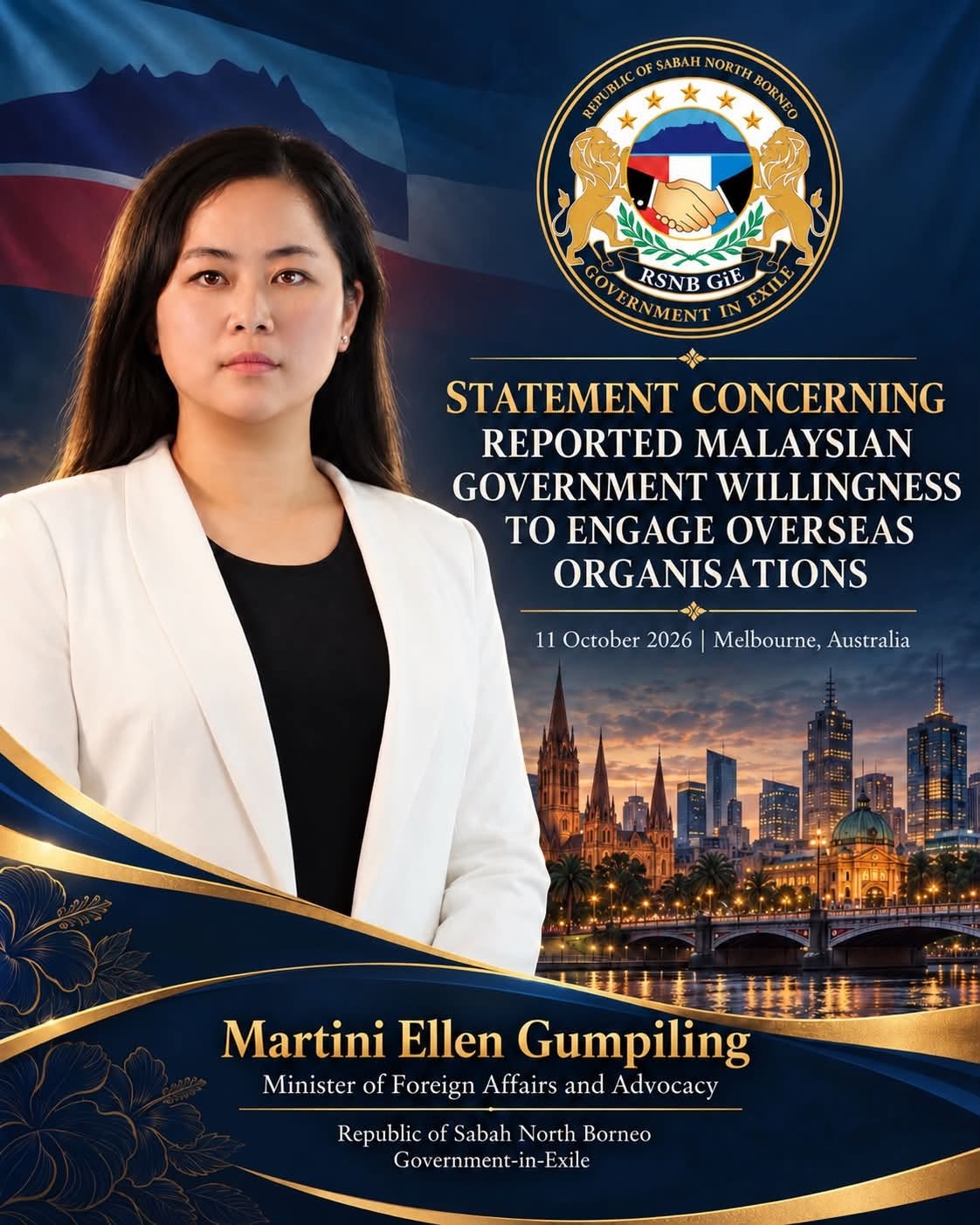 ★ Featured
STATEMENT CONCERNING REPORTED MALAYSIAN GOVERNMENT WILLINGNESS TO ENGAGE OVERSEAS ORGANISATIONS
The Republic of Sabah North Borneo Government-in-Exile (RSNB-GiE) has taken note of media reports dated 10 October 2026 concerning statements by Datuk Mustapha Sakmud,…
Read · 1 min →