
The Republic of Sabah North Borneo Government-in-Exile (RSNB-GiE) refers to the article published by Focus Malaysia on 17 September 2025, entitled “Disgruntled activist moots exiled Sabah gov’t in Down Under as ‘legitimate voice of Sabahans’”, concerning the proclamation of RSNB-GiE in Melbourne, Australia.
While RSNB-GiE recognises and respects the important role of independent journalism in informing the public and encouraging debate, it considers the characterisation of its leadership as merely “disgruntled” to be an inadequate representation of the historical, constitutional and international legal questions underpinning the organisation's establishment.
RSNB-GiE was established to advance, through peaceful, lawful and democratic means, its position that the people of Sabah (formerly North Borneo) possess a continuing right to self-determination and that the historical process through which North Borneo became part of Malaysia in 1963 warrants renewed independent examination.
The organisation's position is based on its interpretation of historical treaties, British colonial records, constitutional instruments, United Nations resolutions and the circumstances surrounding the establishment of Malaysia.
RSNB-GiE therefore considers it necessary to clarify its objectives, distinguish established historical facts from disputed legal interpretations, and explain why it maintains that fundamental questions concerning Sabah's political status and the exercise of its people's right to self-determination deserve serious international consideration.
The Malaysia Agreement 1963 (MA63), signed in London on 9 July 1963, was concluded between the United Kingdom of Great Britain and Northern Ireland, the Federation of Malaya, North Borneo, Sarawak and Singapore.
Article I of the Agreement provided that the colonies of North Borneo and Sarawak, together with Singapore, would be federated with the existing states of the Federation of Malaya, after which the federation would be known as Malaysia.
The constitutional continuity of the existing Federation of Malaya is further reflected in the United Kingdom's Malaysia Act 1963 and the Federation of Malaya's own constitutional amendments.
The official United Nations membership record also confirms that the Federation of Malaya became a member of the United Nations on 17 September 1957 and that its name was changed to Malaysia on 16 September 1963 following the inclusion of Sabah, Sarawak and Singapore. Malaysia was not admitted to the United Nations as an entirely new member state in 1963.
These documentary facts demonstrate the constitutional and institutional continuity between the Federation of Malaya and the subsequently enlarged Federation of Malaysia.
RSNB-GiE maintains that this distinction is significant because it raises questions concerning the constitutional nature of the federation, the political relationship between the existing Malayan states and the newly incorporated Borneo territories, and the extent to which the peoples of North Borneo and Sarawak were afforded an equal and genuinely informed opportunity to determine their future political status.
RSNB-GiE does not contend that constitutional continuity alone conclusively establishes the invalidity of Malaysia's formation. Rather, it argues that the nature of the constitutional transformation must be examined alongside the principles of self-determination, political equality and informed democratic consent applicable to the decolonisation of Non-Self-Governing Territories.
At the time MA63 was signed on 9 July 1963, North Borneo remained under British colonial sovereignty. Its constitutional institutions operated within a framework established under British authority, and it had not become an independently sovereign state possessing unrestricted international treaty-making capacity.
Although North Borneo was expressly named as a participant in the Malaysia Agreement and representatives signed on its behalf, the territory's colonial status raises questions concerning the legal authority exercised by those representatives and the democratic basis upon which they participated in an agreement fundamentally transforming the territory's international and constitutional position.
RSNB-GiE considers it necessary to examine the respective powers of the British colonial administration, the North Borneo Legislative Council and the representatives who participated in the negotiations and signing of MA63.
The organisation maintains that the legal authority to conclude constitutional arrangements under a colonial administration must be distinguished from the question of whether the people themselves exercised their right to self-determination through a sufficiently informed and democratic process.
RSNB-GiE recognises that colonial status does not automatically render an international agreement legally void. Its position is that the authority of the signatories, the representative legitimacy of the institutions concerned and compliance with applicable international decolonisation standards require examination together rather than in isolation.
One of RSNB-GiE's principal concerns is the nature of democratic representation in North Borneo when MA63 was signed.
Prior to the establishment of Malaysia, North Borneo underwent a gradual process of political and constitutional development involving local council elections and indirect representation.
However, at the time the Malaysia Agreement was signed on 9 July 1963, North Borneo had not conducted a territory-wide direct general election to elect its Legislative Assembly.
The indirect electoral arrangements for the territorial Legislative Council were completed later in July 1963, after the signing of MA63. Those arrangements relied upon an electoral college consisting of representatives elected through local authorities rather than a direct popular election of the territorial legislature.
It is particularly significant that Sabah's first direct general election for its State Legislative Assembly did not take place until April 1967, almost four years after the establishment of Malaysia.
RSNB-GiE acknowledges the existence of earlier local elections and indirect electoral representation. Nevertheless, it maintains that these procedures should not be equated automatically with a direct, territory-wide electoral mandate concerning the fundamental constitutional and political future of North Borneo.
The organisation therefore questions whether the institutions participating in the 1963 arrangements possessed a sufficiently direct, representative and informed democratic mandate to determine the territory's future political status.
RSNB-GiE considers this issue central to any serious examination of whether the people of North Borneo were afforded an adequate opportunity to exercise their right to self-determination before the territory became part of Malaysia.
RSNB-GiE's position is informed by the international principles of decolonisation recognised by the United Nations General Assembly.
Resolution 1514 (XV), adopted on 14 December 1960, proclaimed the right of all peoples to self-determination and established an important international framework for bringing colonial rule to an end.
Resolution 1541 (XV), adopted on 15 December 1960, identified the circumstances under which a Non-Self-Governing Territory may be considered to have attained a full measure of self-government.
Principle VI recognises independence, free association with an independent state and integration with an independent state as possible outcomes.
Principles VIII and IX address the standards applicable to integration, including equality of political status and citizenship rights, representative participation and the requirement that integration reflect the freely expressed wishes of the territory's people through informed and democratic processes.
Principle IX specifically addresses the importance of the territory having attained an advanced stage of self-government and of the people being capable of making a responsible political choice with full knowledge of the change in their status.
RSNB-GiE recognises that Resolution 1541 does not expressly require a referendum in every circumstance. Nevertheless, it maintains that the absence of a territory-wide referendum, the indirect character of the electoral arrangements and the colonial constitutional framework existing in 1963 collectively raise legitimate questions about the quality and sufficiency of the process through which public consent was ascertained.
The organisation therefore calls for a renewed examination of the 1963 arrangements against the standards recognised in Principles VIII and IX, particularly concerning informed choice, democratic representation, political equality and the freely expressed wishes of the people.
RSNB-GiE also considers it necessary to distinguish the findings of the Cobbold Commission from a direct democratic exercise of self-determination.
The Commission of Enquiry visited North Borneo and Sarawak between February and April 1962 to ascertain public views concerning the proposed federation.
The Commission received representations, conducted interviews and examined differing opinions before submitting its report and recommendations to the British and Malayan governments.
Although the Commission concluded that the proposed federation was in the interests of the territories, its investigation was a consultative inquiry rather than a referendum or a territory-wide direct election.
RSNB-GiE maintains that consultation with selected individuals, organisations and community representatives, however valuable, is not necessarily equivalent to allowing an entire electorate to make a direct and informed choice concerning its future political status.
The organisation therefore considers it appropriate to revisit the Commission's methodology, the range of political alternatives presented, the interpretation of public opinion and the relationship between its conclusions and the subsequent constitutional decisions taken by the colonial authorities.
The Manila Accord, signed on 31 July 1963 by the Federation of Malaya, Indonesia and the Philippines, expressly recognised the importance of the self-determination of the peoples of the Borneo territories.
Paragraphs 10 and 11 addressed the need for the wishes of the peoples of North Borneo and Sarawak to be ascertained by the United Nations Secretary-General or his representative.
The subsequent Joint Statement of 5 August 1963 further specified that the assessment should take place within the context of Principle IX of United Nations General Assembly Resolution 1541 (XV).
The Joint Statement identified relevant matters for examination, including whether Malaysia had been a major electoral issue, whether electoral registers had been properly compiled, whether elections had been conducted freely and without coercion, whether votes had been properly polled and counted, and whether the wishes of persons excluded from participation by political detention, imprisonment or absence had been adequately considered.
RSNB-GiE maintains that these provisions demonstrate that the legitimacy of the proposed constitutional transformation was understood to depend upon more than agreement among political leaders and colonial authorities.
The organisation considers the safeguards contemplated under the Manila arrangements sufficiently important to justify renewed examination of how they were implemented and whether the procedures ultimately adopted adequately fulfilled their underlying objectives.
RSNB-GiE does not present the alleged non-compliance with the Manila Accord as an established judicial finding. It calls instead for an independent historical and legal assessment of whether the relevant commitments were fulfilled in substance as well as in procedure.
RSNB-GiE acknowledges that a United Nations Mission visited North Borneo and Sarawak in August and September 1963 to ascertain the wishes of the people concerning the proposed establishment of Malaysia.
The Mission examined electoral arrangements, consulted political and community representatives and considered the constitutional circumstances existing within the territories.
The Mission concluded that the wishes of the majority supported participation in Malaysia and that the prevailing constitutional and electoral arrangements were sufficient for the purposes of the assessment undertaken.
RSNB-GiE recognises that these conclusions form part of the official United Nations historical record and must be considered in any responsible examination of the events of 1963.
However, the Mission did not conduct a direct referendum or plebiscite among the people of North Borneo and Sarawak.
Its assessment depended upon consultations, existing electoral outcomes, legislative approval and representations received within a limited period preceding the establishment of Malaysia.
RSNB-GiE maintains that the Mission's conclusions should not prevent subsequent independent scrutiny of its methodology, the representativeness of the underlying electoral arrangements, the time available for public consideration and the extent to which alternative political futures were meaningfully available for examination.
The organisation considers it particularly important to determine whether support for the proposed federation, as assessed through the procedures used in 1963, was equivalent to the freely expressed and informed democratic choice contemplated by international decolonisation principles.
RSNB-GiE therefore calls for a comprehensive review of the Mission's documentary records, consultation procedures, evidence and conclusions, while recognising that any challenge to its historical findings must be supported by demonstrable evidence rather than assertion alone.
RSNB-GiE further considers that the implementation of the Malaysia Agreement and the subsequent evolution of the federal constitutional framework deserve careful historical and legal examination.
The original Malaysia Agreement was amended by a further agreement signed in Singapore on 28 August 1963, which addressed the change in the date of Malaysia's establishment. The United Nations Treaty Collection records the Agreement as having entered into force on 16 September 1963 and having been registered with the United Nations on 21 September 1970.
These dates and amendments form part of the documented treaty history. Their existence does not, by itself, establish that the Agreement was invalid or that the establishment of Malaysia remained legally incomplete.
Nevertheless, RSNB-GiE maintains that subsequent legislative amendments, constitutional changes and diplomatic correspondence should be examined to determine whether the original arrangements and safeguards intended for North Borneo and Sarawak were fully and consistently implemented.
Particular attention should be given to citizenship arrangements, the constitutions of the Borneo states, immigration controls, the distribution of federal and state authority, policing and security jurisdiction, and the constitutional protections intended to preserve the distinct interests of the territories.
The organisation also calls for systematic examination of relevant British Commonwealth Office, Colonial Office and diplomatic correspondence, including records from 1966 and 1967, insofar as those documents concern the implementation, interpretation or alteration of the original constitutional arrangements.
Any such investigation must distinguish amendments to MA63 itself from amendments to domestic legislation, state constitutions or administrative procedures. It must also establish the dates, legal authority and effects of the changes concerned.
RSNB-GiE maintains that subsequent developments may be relevant to assessing whether constitutional undertakings made in 1963 were honoured. However, it recognises that allegations of unlawful alteration, defective implementation or breach of constitutional guarantees must be established through identified primary records and sound legal analysis.
The United Kingdom's Malaysia Act 1963 provided for the relinquishment of British sovereignty and jurisdiction over North Borneo, Sarawak and Singapore in connection with their entry into Malaysia.
RSNB-GiE acknowledges that this legislation formed part of the legal mechanism through which British colonial sovereignty was brought to an end in the territories concerned.
The organisation does not contend that the existence of British diplomatic correspondence after September 1963, by itself, proves that British colonial sovereignty legally continued.
Its concern is instead whether the constitutional transition and the arrangements through which sovereignty was relinquished were accompanied by an adequate exercise of self-determination by the people of North Borneo.
RSNB-GiE maintains that the formal ending of colonial sovereignty and the substantive fulfilment of the right to self-determination are related but analytically distinct questions.
The organisation therefore believes that a complete historical assessment must consider both the constitutional instruments by which sovereignty was transferred and the representative and democratic processes through which the people were said to have consented to their new political status.
RSNB-GiE maintains that the questions surrounding North Borneo's incorporation into Malaysia have not been satisfactorily resolved from the standpoint of its interpretation of the historical record and international principles of self-determination.
The organisation considers the issue fundamentally one of decolonisation and the right of a people to determine their political future, rather than simply a matter of contemporary dissatisfaction with federal governance or a political demand for secession.
This is RSNB-GiE's political and legal position. It does not represent a determination already made by an international court or a universally accepted conclusion concerning Malaysia's territorial status.
RSNB-GiE also recognises that Sabah is not presently included on the United Nations list of the seventeen remaining Non-Self-Governing Territories.
The organisation's request for renewed international consideration should therefore be understood as a call for the historical and legal basis of Sabah's decolonisation to be independently reassessed, rather than as an assertion that the United Nations has already formally determined that Sabah remains an incompletely decolonised territory.
RSNB-GiE believes that a credible reassessment should examine the circumstances of 1963, the constitutional framework adopted, the quality of the processes used to ascertain public consent and the continuing relevance of international principles protecting the right of peoples to self-determination.
Such an examination should be conducted with due regard for the United Nations Charter, the applicable international legal framework, the rights of all communities in Sabah and the importance of regional peace and stability.
RSNB-GiE was proclaimed in September 2025, with its establishment taking effect on 16 September 2025, as a political institution dedicated to advancing what it regards as the historical and continuing right of the people of Sabah to determine their political future.
The organisation's stated objective is to advocate internationally for a peaceful, democratic and lawful process through which the people of Sabah may examine their historical circumstances and exercise their political rights.
RSNB-GiE asserts a political and moral mandate to advocate for the cause of Sabah's self-determination. It recognises, however, that its proclamation does not automatically confer international governmental recognition or establish an exclusive electoral mandate to represent every inhabitant of Sabah.
Its work is intended to advance public education, historical research, international legal analysis, diplomatic engagement and peaceful democratic participation.
The organisation maintains that its ultimate objective is the achievement of Sabah's independence and sovereignty through legitimate, peaceful and internationally defensible means, consistent with the freely expressed wishes of its people.
RSNB-GiE further affirms that the political future of Sabah must not be determined through intimidation, armed conflict, coercion or the exclusion of communities holding different political opinions.
Any future process addressing Sabah's political status must uphold fundamental human rights, political equality, inclusive participation and the principles of free and informed democratic choice.
Should the organisation's objective of independence be achieved through a legitimate process, RSNB-GiE's stated intention is to facilitate the peaceful transfer of authority to a democratically established government within Sabah, acting in accordance with the freely expressed will of its people.
RSNB-GiE respectfully calls upon the international community, including relevant United Nations institutions, independent legal scholars, historians, human rights organisations and governments concerned with international law and decolonisation, to give serious consideration to the historical and constitutional questions surrounding North Borneo's political transition in 1963.
The organisation calls for greater accessibility to relevant colonial archives, constitutional records, diplomatic correspondence, electoral documentation and the materials concerning the Cobbold Commission and the 1963 United Nations Mission.
RSNB-GiE further encourages independent academic and legal examination of these materials, including evidence that supports or challenges the organisation's own interpretation of the historical events.
The organisation believes that the historical record should be subjected to rigorous scrutiny, with findings based on authenticated documents, transparent methodology and applicable international legal principles.
RSNB-GiE remains willing to engage constructively with relevant institutions and authorities through peaceful, lawful and appropriately authorised diplomatic channels.
It considers dialogue, transparency, historical accountability and democratic participation essential to any credible effort to address the longstanding constitutional and political questions affecting Sabah.
RSNB-GiE respects the role of the media in scrutinising political organisations, examining historical claims and reporting differing interpretations of constitutional and international legal questions.
However, it encourages media organisations to distinguish between political characterisations, documentary historical facts, contested legal arguments and the publicly declared objectives of organisations advocating self-determination.
The establishment of RSNB-GiE should not be assessed solely through personal descriptions of its leadership or disagreements with its political objectives.
The organisation believes that its arguments deserve to be examined on the basis of the historical evidence, legal instruments and principles upon which they are advanced.
RSNB-GiE welcomes factual scrutiny, reasoned criticism and informed debate. It remains committed to correcting inaccuracies, acknowledging relevant counter-evidence and presenting its position through responsible public communication.
RSNB-GiE reaffirms that its establishment represents a peaceful political initiative intended to advance public awareness, historical accountability and the right of the people of Sabah to determine their own political future.
The organisation maintains that the constitutional formation of Malaysia in 1963, the democratic circumstances existing in North Borneo at the time, the implementation of the Manila Accord, the conclusions of the United Nations Mission and the subsequent development of Sabah's constitutional position collectively warrant renewed independent examination.
RSNB-GiE's position is not that every disputed legal question has already been conclusively determined in its favour. Its position is that the historical record contains sufficiently serious questions to justify further investigation, public discussion and international legal consideration.
The organisation's commitment remains firmly grounded in peaceful advocacy, democratic participation, the protection of human rights, respect for the rule of law and the pursuit of a legitimate and internationally defensible process of self-determination.
The future of Sabah must ultimately be determined by its people through a free, informed, peaceful and democratic process, conducted in accordance with applicable international law and with full respect for the rights and dignity of all its communities.
RSNB-GiE will continue to advance this position through historical research, public education, international engagement and lawful democratic advocacy.
ENDS
ISSUED BY:
Office of the President
Republic of Sabah North Borneo Government-in-Exile (RSNB-GiE)
Original Statement: 23 September 2025
Revised and Updated: 19 October 2026
DOCUMENTARY REFERENCES
The following primary records and official sources provide the historical and legal context for this statement. The references do not, by themselves, establish every legal interpretation advanced by RSNB-GiE.
-
Agreement relating to Malaysia, 9 July 1963. United Nations Treaty Series, Volume 750, No. 10760, including the amending agreement of 28 August 1963. United Nations Treaty Collection.
-
Malaysia Act 1963 (United Kingdom), Chapter 35. Enacted on 31 July 1963. UK Legislation.
-
United Nations General Assembly Resolution 1514 (XV), 14 December 1960. Declaration on the Granting of Independence to Colonial Countries and Peoples. UN Digital Library.
-
United Nations General Assembly Resolution 1541 (XV), 15 December 1960. Principles which should guide Members in determining whether an obligation exists to transmit information under Article 73(e) of the Charter. UN Digital Library.
-
Report of the Commission of Enquiry, North Borneo and Sarawak, 1962. Commonly known as the Cobbold Commission Report, Cmd. 1794. Historical document.
-
Manila Accord, 31 July 1963, and Joint Statement, 5 August 1963. United Nations Treaty Series, Volume 550, No. 8029. United Nations Treaty Collection PDF.
-
United Nations Yearbook 1963. The Question of Malaysia, including the findings of the United Nations Mission to North Borneo and Sarawak. UN Digital Library.
-
Dewan Rakyat Parliamentary Debates, 15 June 1966. Discussion concerning direct elections to the Federal Parliament and State Legislative Assembly in Sabah. Parliament of Malaysia.
-
United Nations Membership Record — Malaysia. Historical membership information concerning the Federation of Malaya and Malaysia. United Nations.
-
United Nations — Non-Self-Governing Territories. Current territories on the United Nations decolonisation list. United Nations.
-
Focus Malaysia, 17 September 2025. “Disgruntled activist moots exiled Sabah gov’t in Down Under as ‘legitimate voice of Sabahans’.” Original article.
Keep reading
 New
RSNB-GiE Responds to Claims Concerning Its Legal Standing and Calls for Independent Examination of North Borneo's 1963 Constitutional Transition
RSNB-GiE Responds to Claims Concerning Its Legal Standing and Calls for Independent Examination of North Borneo's 1963 Constitutional Transition The Republic of Sabah North…
Read · 25 min →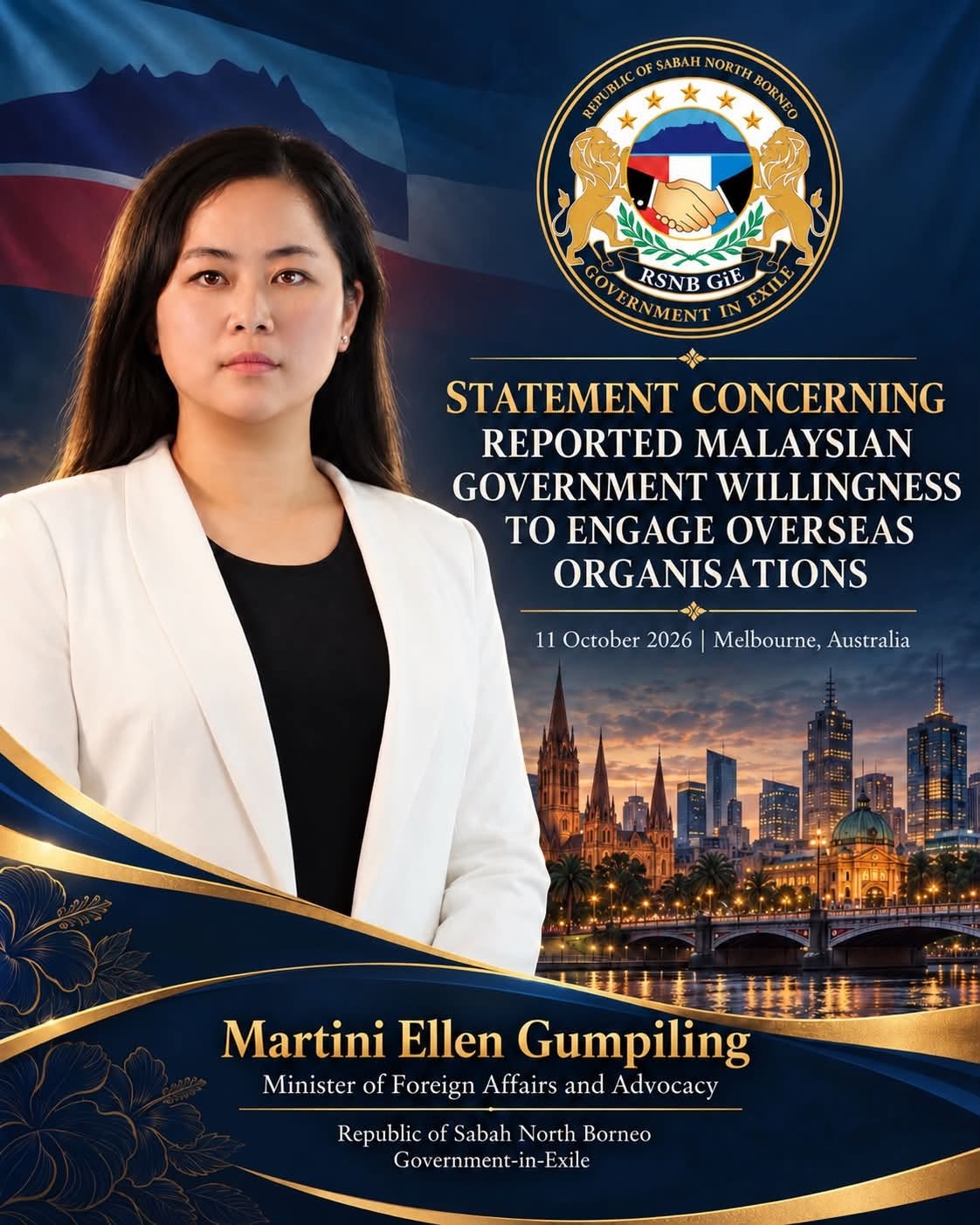 ★ Featured
STATEMENT CONCERNING REPORTED MALAYSIAN GOVERNMENT WILLINGNESS TO ENGAGE OVERSEAS ORGANISATIONS
The Republic of Sabah North Borneo Government-in-Exile (RSNB-GiE) has taken note of media reports dated 10 October 2026 concerning statements by Datuk Mustapha Sakmud,…
Read · 1 min →
STATEMENT OF CONDOLENCES ON THE PASSING OF TUN DR HASMAH MOHAMAD ALI
The Republic of Sabah North Borneo Government-in-Exile (RSNB-GiE) extends its deepest condolences to Tun Dr Mahathir Mohamad, his family, relatives and loved ones following…
Read · 1 min →