
RSNB-GiE Responds to Claims Concerning Its Legal Standing and Calls for Independent Examination of North Borneo's 1963 Constitutional Transition
The Republic of Sabah North Borneo Government-in-Exile (RSNB-GiE) issues this revised statement in response to two reports published by The Sun Malaysia on 18 September 2025, entitled "Self-declared regime devoid of legal standing" and "‘Govt-in-exile’ group may incite unrest, undermine unity: Expert."
The reports presented critical opinions concerning RSNB-GiE's establishment, political legitimacy, legal standing and advocacy for Sabah's self-determination. Among the arguments reported were suggestions that the organisation lacked lawful authority and that its activities might constitute a threat to public order or national unity.
RSNB-GiE respects freedom of the press and the right of political leaders, legal scholars and members of the public to express differing views. Nevertheless, the organisation rejects the suggestion that the historical and legal questions underlying its political position can be dismissed solely by reference to Malaysia's existing constitutional framework.
The central question raised by RSNB-GiE concerns the circumstances through which British North Borneo, then a colonial territory administered by the United Kingdom, became part of Malaysia on 16 September 1963.
RSNB-GiE maintains that this question requires an examination not only of Malaysia's domestic constitutional arrangements, but also of the international principles governing decolonisation, the democratic authority of colonial representatives, the methods used to ascertain the wishes of the population and the diplomatic circumstances surrounding the establishment of Malaysia.
The organisation recognises that Malaysia is an internationally recognised sovereign state and a Member State of the United Nations. However, RSNB-GiE maintains that recognition of the existing state does not, in itself, remove the historical processes leading to its establishment from legitimate scholarly and legal scrutiny.
RSNB-GiE therefore calls for an impartial, evidence-based examination of North Borneo's constitutional transition and the application of the right of peoples to self-determination in 1963.
The right of peoples to self-determination is recognised under Article 1(2) of the Charter of the United Nations and forms an important part of the international legal framework governing decolonisation.
United Nations General Assembly Resolution 1514 (XV), adopted on 14 December 1960, established the Declaration on the Granting of Independence to Colonial Countries and Peoples.
Resolution 1541 (XV), adopted on 15 December 1960, subsequently identified three possible means by which a Non-Self-Governing Territory may attain a full measure of self-government: independence, free association with an independent state or integration with an independent state.
RSNB-GiE considers Principles VIII and IX of Resolution 1541 particularly relevant to the historical examination of North Borneo.
Principle VIII concerns equality between the peoples of an integrating territory and those of the independent state with which it integrates, including citizenship, fundamental rights and opportunities for effective participation in governmental institutions.
Principle IX establishes important conditions concerning integration, including that the integrating territory should have attained an advanced stage of self-government with free political institutions capable of enabling its population to make a responsible political choice through informed and democratic processes.
It further provides that integration should reflect the freely expressed wishes of the population, acting with full knowledge of the proposed change in political status, through impartial democratic processes based on universal adult suffrage.
RSNB-GiE acknowledges that Resolution 1541 does not expressly require a referendum as the exclusive method of establishing popular consent in every circumstance.
Nevertheless, RSNB-GiE maintains that the absence of a direct popular referendum in North Borneo in 1963, when considered alongside the territory's limited self-governing institutions and indirect political representation, raises significant questions concerning the adequacy of the process through which public consent was established.
The central issue is therefore whether the procedures undertaken in 1963 sufficiently demonstrated the free, informed and genuine wishes of the people of North Borneo in accordance with the applicable international standards.
RSNB-GiE considers this a substantive legal and historical question that cannot be conclusively resolved merely by referring to the formal signing and subsequent implementation of the Malaysia Agreement 1963.
RSNB-GiE considers the democratic and constitutional authority of North Borneo's representatives at the time of the signing of the Malaysia Agreement 1963 to be one of the most important issues requiring independent examination.
On 20 March 1963, the British Government informed the House of Commons that the North Borneo Legislative Council had consisted of 18 unofficial members nominated by the Governor, following consultations with local authorities, and seven official members.
The British Government further explained that the territory was undergoing electoral reforms under which the unofficial members of the Legislative Council would be selected through an indirect electoral-college system.
Although local government elections based on adult suffrage had been introduced, North Borneo had not established an independently sovereign government or a directly elected territorial legislature exercising a popular mandate comparable to that of an independent democratic state.
The Malaysia Agreement was signed in London on 9 July 1963, while North Borneo remained under British colonial administration.
At that time, the territory's process of selecting Legislative Council representatives through indirect elections had not yet been completed.
The indirect elections to the Legislative Council were completed later in July 1963, after the Agreement had already been signed. These elections were conducted through an electoral-college arrangement involving representatives elected to local authorities, rather than through a direct territory-wide election of Legislative Council members by the general electorate.
Consequently, the legislative representatives participating in the political processes surrounding Malaysia's establishment must be distinguished from representatives directly elected by the people of North Borneo to determine their future constitutional status.
North Borneo representatives participated in the negotiations and signed the Agreement alongside representatives of the United Kingdom, the Federation of Malaya, Sarawak and Singapore.
RSNB-GiE does not deny their participation or the formal execution of the Agreement.
However, the organisation maintains that the involvement of colonial representatives and the formal signing of an international agreement must be distinguished from the separate question of whether the representatives possessed an adequately established democratic mandate from the population whose political status was to be fundamentally altered.
North Borneo was not an independent sovereign state when MA63 was signed, and the territory's constitutional authority remained subject to British colonial administration.
RSNB-GiE therefore considers it necessary to examine the legal and constitutional basis upon which the North Borneo representatives acted, the extent of their authority under colonial law and the relationship between that authority and the international requirement to ascertain the freely expressed wishes of the people.
The organisation recognises that colonial territories have historically participated in independence and integration arrangements through representatives operating within colonial constitutional frameworks, and that the absence of independent statehood does not automatically invalidate such arrangements.
Nevertheless, RSNB-GiE maintains that colonial administrative authority and popular democratic consent are distinct considerations that must be examined carefully when assessing the implementation of self-determination.
A further historical distinction of substantial importance concerns the timing of Sabah's first direct election to its State Legislative Assembly.
Although local government elections and indirect Legislative Council elections took place during the period preceding Malaysia's establishment, Sabah did not conduct its first direct election to the State Legislative Assembly until 8–23 April 1967, almost four years after the Malaysia Agreement was signed on 9 July 1963.
This chronology is confirmed by the official records of the Malaysian Parliament.
During the parliamentary sitting of 6 June 1968, an official government report recorded that polling in the first direct election to the Sabah State Assembly had been successfully conducted between 8 and 23 April 1967.
The distinction between the 1963 indirect electoral arrangements and the 1967 direct election is fundamental to an accurate understanding of North Borneo's democratic development.
The former involved an electoral-college system operating during the final period of British colonial administration. The latter enabled Sabah's electorate to vote directly for representatives to its State Legislative Assembly.
Furthermore, Section 94 of the Malaysia Act 1963, enacted by the Parliament of the Federation of Malaya, expressly provided for a transitional period of indirect elections to the House of Representatives and the Legislative Assemblies in the Borneo States.
The original transitional provisions contemplated indirect elections continuing until the relevant dissolution following August 1968, subject to provisions permitting an earlier transition.
The eventual direct State Legislative Assembly election in Sabah in April 1967 occurred within this subsequent constitutional development.
These provisions demonstrate that the constitutional arrangements establishing Malaysia themselves contemplated a period during which direct territorial legislative elections would not be conducted in the Borneo States.
RSNB-GiE maintains that this circumstance is significant to the question of democratic consent because the political status of North Borneo had already changed substantially before its population participated in a direct State Legislative Assembly election.
The organisation does not contend that direct legislative elections constitute the only possible method through which self-determination can be exercised.
However, it maintains that the absence of such an election before Malaysia's establishment places greater importance upon examining whether the alternative electoral and consultative procedures employed in 1963 were sufficiently democratic, impartial and representative.
RSNB-GiE therefore calls for independent examination of whether the representative institutions and political processes available to North Borneo in 1963 adequately satisfied the requirements of free, informed and genuine self-determination under United Nations General Assembly Resolution 1541 (XV), particularly Principle IX.
RSNB-GiE considers it important to acknowledge that organised political opposition to the proposed constitutional arrangements existed before the Malaysia Agreement was signed.
A joint memorandum dated 9 September 1962 was submitted to the United Nations by representatives of the United National Pasok Momogun Party of North Borneo, the Party Rakyat of Brunei and the Sarawak United Peoples' Party.
The memorandum was circulated within the United Nations under document A/AC.109/PET.46, dated 17 September 1962.
The petition expressed concerns regarding the proposed transfer of sovereignty over North Borneo and Sarawak and argued that the political future of their peoples should be determined in accordance with the principle of self-determination.
Among the proposals advanced were United Nations involvement in the question, consideration of a United Nations-supervised plebiscite and examination of alternative political arrangements involving the Borneo territories.
This document demonstrates that objections concerning colonial authority, political consent and self-determination were raised contemporaneously and brought to the attention of the United Nations before the formal signing of MA63.
RSNB-GiE does not contend that the petition, by itself, establishes that a majority of the population of North Borneo opposed Malaysia.
However, the document provides historical evidence that alternative political aspirations and concerns regarding the proposed constitutional transition existed and were expressed through organised political channels.
RSNB-GiE maintains that these expressions of opposition must be considered alongside the evidence of support for Malaysia when examining whether the population was afforded an adequately informed and democratic choice concerning its political future.
The Manila Accord, signed on 31 July 1963 by the Federation of Malaya, Indonesia and the Philippines, represents an important diplomatic development concerning the proposed establishment of Malaysia.
Paragraph 10 of the Accord reaffirmed adherence to the principle of self-determination for the peoples of Non-Self-Governing Territories.
Indonesia and the Philippines indicated their willingness to welcome Malaysia's formation provided that support from the peoples of the Borneo territories was ascertained by an independent and impartial authority, namely the United Nations Secretary-General or his representative.
The subsequent Joint Statement of 5 August 1963 established arrangements for this ascertainment.
These diplomatic instruments demonstrate that the question of popular consent was recognised internationally as an important consideration in the proposed constitutional transition.
RSNB-GiE acknowledges that the subsequent United Nations Malaysia Mission was established in response to these arrangements.
Nevertheless, the organisation maintains that the diplomatic commitment to ascertain public wishes must be distinguished from the separate question of whether the procedures ultimately employed were sufficient to fulfil that commitment.
RSNB-GiE therefore considers the Manila Accord and the Joint Statement of 5 August 1963 essential documentary references for an independent examination of the 1963 process.
RSNB-GiE acknowledges that the United Nations Secretary-General established a mission in August 1963 to ascertain the wishes of the peoples of North Borneo and Sarawak regarding the proposed establishment of Malaysia.
The Mission was headed by Laurence V. Michelmore, acting as the Secretary-General's representative, and comprised eight United Nations Secretariat officers divided into two teams.
According to United Nations historical records, the Mission arrived in Sarawak on 16 August 1963 and conducted its work in the two territories until 5 September 1963.
However, RSNB-GiE considers several features of the Mission's arrangements worthy of independent scrutiny.
First, the Malaysia Agreement had already been signed on 9 July 1963, before the Mission commenced its inquiry.
Second, the Mission operated within a relatively short period immediately preceding the scheduled establishment of Malaysia.
Third, United Nations records confirm that observers from the United Kingdom and the Federation of Malaya attended the Mission's hearings throughout its work, while observers from Indonesia and the Philippines arrived on 1 September and attended hearings on 2, 3 and 4 September.
The differing periods of observer participation were significant because the Mission had been established following diplomatic discussions involving governments holding different positions concerning Malaysia's establishment.
RSNB-GiE recognises that late observer participation does not, by itself, establish that the Mission's personnel acted improperly or that its conclusions were predetermined.
Nevertheless, the organisation considers that the practical consequences of these arrangements, including the extent of international observation available during the hearings, deserve careful examination.
Further questions arise from the fact that 16 September 1963 was publicly announced as the new date for Malaysia's establishment on 29 August 1963, before the Mission had completed its work.
The United Nations Secretary-General's final conclusions were subsequently made public on 14 September 1963, only two days before Malaysia was established.
RSNB-GiE maintains that the sequencing of these events raises legitimate questions concerning the relationship between the political timetable for Malaysia's establishment and the international process intended to ascertain the wishes of the peoples of the Borneo territories.
The organisation does not assert that this chronology alone proves that the Mission was improperly influenced.
Its position is that the compressed timetable, differing observer arrangements and advance political commitment to the federation's establishment warrant independent assessment of whether the ascertainment process was sufficiently open, impartial and capable of informing the final political decision.
RSNB-GiE further considers that the Mission's work should be examined in the context of the wider diplomatic interests surrounding Malaysia's proposed establishment.
Declassified Australian diplomatic records demonstrate that Australia publicly and privately supported the formation of Malaysia before the United Nations Malaysia Mission commenced its work.
An Australian record of the June 1963 ANZUS discussions documents the position of Australia's Minister for External Affairs, Sir Garfield Barwick, that Malaysia represented the preferred political arrangement for the territories concerned.
The record also shows that Barwick opposed proposals for a plebiscite that included independence among the available alternatives, expressing concern that such a choice could divert attention from the proposed federation.
RSNB-GiE considers this evidence important because it demonstrates that influential governments supporting Malaysia held established political preferences concerning the territories' future and the methods through which public consent should be assessed.
The organisation recognises that the existence of diplomatic preferences is not unusual in international affairs and does not automatically establish unlawful interference in a United Nations process.
Nevertheless, RSNB-GiE maintains that the influence of regional security considerations, colonial policy and the strategic interests of governments supporting Malaysia should be examined when assessing the wider circumstances in which the Mission was established and conducted.
RSNB-GiE therefore calls for relevant British, Australian, United Nations and other diplomatic records to be examined together, rather than treating any individual government's interpretation as conclusive.
RSNB-GiE acknowledges that the United Nations Secretary-General ultimately accepted the Mission's findings and concluded that a substantial majority of the peoples of North Borneo and Sarawak wished to join the proposed federation.
The Secretary-General also accepted the Mission's assessment that the procedures undertaken satisfied Principle IX of Resolution 1541.
These conclusions constitute an important part of the historical and international record and must be considered in any credible assessment of the 1963 process.
RSNB-GiE does not seek to conceal or disregard them.
However, the organisation maintains that the Mission's conclusions must be examined alongside the actual constitutional and electoral arrangements available to the people of North Borneo at the time.
The distinction between local government elections, indirect Legislative Council elections and direct State Legislative Assembly elections is particularly important.
Although the Mission considered the electoral and consultative processes of 1963 sufficient to establish the wishes of the population, Sabah's first direct State Legislative Assembly election was not conducted until April 1967.
RSNB-GiE maintains that this chronology raises a substantive question about the weight placed upon indirect political representation and consultations conducted under colonial administration.
The Mission also considered allegations concerning electoral procedures, political detentions and restrictions affecting particular individuals.
It concluded that the number of eligible voters detained for political offences or absent from the territories was insufficient to affect the electoral results materially.
RSNB-GiE recognises this conclusion while maintaining that the underlying evidence and methodology remain legitimate subjects for historical examination.
The existence of emergency measures and political detentions during the wider period should be examined with attention to their actual causes, scope and consequences.
RSNB-GiE does not assert, without further evidence, that every arrest or emergency measure was directed at suppressing peaceful opposition to Malaysia.
Nevertheless, the organisation considers it appropriate to examine whether political restrictions, colonial security arrangements or other circumstances materially affected the ability of individuals and political organisations to participate freely in discussions concerning the proposed federation.
RSNB-GiE therefore seeks independent reassessment of the historical record rather than asserting that the United Nations had already reached the legal conclusions now advanced by the organisation.
The legal character of Malaysia's establishment is another important consideration in the examination of North Borneo's constitutional transition.
Article I of the Malaysia Agreement 1963 provided that North Borneo, Sarawak and Singapore would be federated with the existing states of the Federation of Malaya and that the enlarged federation would thereafter be called Malaysia.
The constitutional arrangements were implemented through amendments to the existing federal constitutional framework.
The United Nations Office of Legal Affairs examined the consequences of these arrangements in a memorandum reproduced in the United Nations Juridical Yearbook 1963, under the heading "Membership of Malaysia in the United Nations."
The memorandum explained that Malaysia's establishment involved the enlargement of the Federation of Malaya, constitutional amendments and a change of name without a break in its international legal personality.
The United Nations' official membership record continues to identify 17 September 1957 as the date on which the Federation of Malaya joined the United Nations, followed by the change of name to Malaysia on 16 September 1963.
RSNB-GiE considers this documentary evidence significant because it demonstrates that Malaysia's establishment involved continuity with the existing Federation of Malaya rather than the creation of an entirely new international legal person comprising previously sovereign and equal states.
However, RSNB-GiE acknowledges that constitutional continuity does not, by itself, establish that North Borneo's incorporation was unlawful.
The organisation's argument concerns the relationship between that constitutional structure, the colonial status of North Borneo, the authority of its representatives and the requirements of self-determination.
RSNB-GiE maintains that these issues must be examined together when assessing the historical and legal character of the 1963 arrangements.
The Agreement relating to Malaysia was signed on 9 July 1963, entered into force on 16 September 1963 and was registered with the United Nations Secretariat on 21 September 1970 under Treaty Registration No. 10760, appearing in Volume 750 of the United Nations Treaty Series.
RSNB-GiE considers the interval between the Agreement's entry into force and its registration worthy of documentary examination.
However, the organisation recognises that delayed registration does not automatically render an international agreement invalid under Article 102 of the United Nations Charter.
RSNB-GiE therefore does not rely upon delayed registration as independent proof that MA63 was void from its inception.
Its principal legal concerns instead relate to the circumstances of consent, the constitutional authority of colonial representatives and the compatibility of the integration process with the applicable principles of self-determination.
RSNB-GiE acknowledges that the declaration or establishment of a government-in-exile does not automatically confer sovereign statehood, diplomatic recognition or authority to govern a territory under international law.
The organisation does not suggest that its institutional title, by itself, establishes recognition by the United Nations or other sovereign states.
Nevertheless, RSNB-GiE maintains that the absence of recognition as a government must be distinguished from the ability of individuals and political organisations to pursue peaceful advocacy, historical research, public education and lawful international engagement.
RSNB-GiE operates as a political and institutional platform advancing its position concerning North Borneo's historical right to self-determination.
Its claimed representative legitimacy must be developed and assessed through transparent governance, voluntary public participation, democratic accountability, respect for fundamental rights and the credibility of the mandate it seeks to establish.
RSNB-GiE does not claim that its declaration constitutes an independently verified electoral mandate from the entire population of Sabah.
Rather, it seeks to advance its objectives through the development of accountable institutions and democratic procedures that respect the principle that Sabah's political future must reflect the freely expressed wishes of its people.
The organisation maintains that peaceful political advocacy should be evaluated according to actual conduct and applicable legal standards, rather than being dismissed solely because its political interpretation differs from that of the Malaysian Government.
RSNB-GiE categorically rejects any suggestion that its peaceful advocacy for self-determination necessarily constitutes incitement to unrest, violence or unlawful political activity.
The organisation does not advocate armed rebellion, terrorism, intimidation, violence against civilians or attacks against public institutions.
Its objectives are pursued through historical and legal research, public education, peaceful assembly, democratic participation, international engagement and lawful political dialogue.
RSNB-GiE recognises that Malaysia maintains domestic criminal laws governing public order and national security.
However, the organisation maintains that allegations of criminal conduct must be assessed according to identifiable acts and the requirements of applicable law, rather than presumed solely from the expression of political opinions concerning self-determination.
The rights to freedom of expression, peaceful assembly and association remain important principles in assessing the treatment of political advocacy.
RSNB-GiE does not claim that invoking self-determination creates an unrestricted exemption from applicable criminal law.
Its position is that peaceful political expression, including historical criticism and proposals for constitutional change, should not automatically be equated with violence or criminal wrongdoing.
The organisation remains committed to peaceful, lawful and democratic methods and encourages constructive engagement rather than confrontation.
RSNB-GiE maintains that its political objectives arise from the historical circumstances of North Borneo's transition from British colonial administration into Malaysia.
For this reason, the organisation characterises its cause as one of decolonisation and self-determination rather than conventional secession from an existing sovereign state.
RSNB-GiE acknowledges that this characterisation is contested.
It further acknowledges that Sabah is presently recognised internationally as part of Malaysia and is not included on the current United Nations list of Non-Self-Governing Territories.
The organisation does not contend that international law automatically establishes an entitlement to separate statehood whenever a political movement asserts the right to self-determination.
Instead, RSNB-GiE maintains that the circumstances of North Borneo's 1963 constitutional transition justify renewed examination of whether the relevant decolonisation standards were adequately fulfilled.
The International Court of Justice's advisory opinion of 25 February 2019 concerning the Chagos Archipelago demonstrates the importance international law places upon the free and genuine expression of the will of peoples under colonial administration.
RSNB-GiE recognises that the Chagos case involved different historical and legal circumstances and did not determine the legal status of Sabah or the validity of MA63.
Nevertheless, the organisation considers the principles discussed in that opinion relevant to the broader examination of colonial consent and the implementation of self-determination.
RSNB-GiE therefore seeks a reasoned legal and historical assessment rather than presenting its interpretation as a conclusion already established by an international court.
RSNB-GiE respects the responsibility of journalists and media organisations to report differing opinions concerning controversial political and constitutional questions.
However, the organisation considers that reporting on North Borneo's constitutional history should distinguish between established documentary facts, competing legal interpretations, political opinions and allegations concerning organisational conduct.
RSNB-GiE encourages The Sun Malaysia and other media organisations to examine the relevant United Nations documents, British parliamentary records, Malaysian parliamentary records, diplomatic correspondence, the Manila Accord and the Malaysia Agreement 1963.
These documents establish that North Borneo's political transition involved complex questions of colonial administration, representative authority, international diplomacy and public consent.
In particular, the documented distinction between the indirect elections of 1963 and Sabah's first direct State Legislative Assembly election in April 1967 should be recognised when assessing the democratic character of North Borneo's constitutional transition.
The organisation welcomes rigorous scrutiny of its own claims and considers that comparable standards of factual accuracy and legal precision should apply to all participants in the debate.
RSNB-GiE remains prepared to engage respectfully with journalists, historians, legal scholars and members of the public through evidence-based discussion.
RSNB-GiE calls for an independent historical and international legal examination of North Borneo's constitutional transition in 1963.
Such an examination should address the constitutional authority through which North Borneo entered the Malaysia Agreement, the development of democratic institutions under British colonial administration, the methods used to ascertain public consent and the application of United Nations General Assembly Resolution 1541.
It should also examine the significance of the 1963 indirect Legislative Council elections, the fact that Sabah's first direct State Legislative Assembly election was not conducted until April 1967, and the implications of these circumstances for assessing the democratic legitimacy of the 1963 transition.
Furthermore, the examination should consider the 1962 petition submitted to the United Nations, the Manila diplomatic arrangements, the work and findings of the United Nations Malaysia Mission, the available electoral evidence and the wider political circumstances surrounding Malaysia's establishment.
Particular attention should be given to distinguishing the international legal continuity of the Federation of Malaya from the separate question of whether North Borneo's incorporation satisfied the relevant standards governing colonial integration.
The examination should consider fairly both the evidence supporting the existing constitutional arrangements and the objections raised concerning the legitimacy and adequacy of the process.
RSNB-GiE invites independent historians, international legal scholars, researchers, civil society organisations and relevant international institutions to examine these matters objectively.
The organisation encourages peaceful engagement with the Malaysian Government and other relevant parties where such engagement may contribute to historical clarity, democratic participation and respect for fundamental human rights.
Any future political process concerning Sabah's constitutional status should be transparent, peaceful, inclusive, genuinely democratic and consistent with applicable international law.
The Republic of Sabah North Borneo Government-in-Exile reaffirms its commitment to the peaceful, democratic and lawful pursuit of self-determination.
RSNB-GiE recognises Malaysia's existing international status and acknowledges that the United Nations Secretary-General accepted the conclusions of the 1963 Malaysia Mission.
Nevertheless, the organisation maintains that the historical processes surrounding North Borneo's incorporation into Malaysia remain legitimate subjects for scholarly examination and reasoned legal debate.
The documentary record establishes that North Borneo remained under British colonial administration when the Malaysia Agreement was signed on 9 July 1963, that its democratic institutions were still developing, and that the indirect elections to its Legislative Council were completed only after the Agreement had already been signed.
The record further confirms that Sabah's first direct State Legislative Assembly election was conducted between 8 and 23 April 1967, almost four years after the establishment of Malaysia.
This distinction is central to RSNB-GiE's concern regarding whether the political arrangements operating in 1963 adequately demonstrated the freely expressed and informed wishes of the people of North Borneo.
The historical record also establishes that organised political opposition to the proposed constitutional arrangements existed before Malaysia's establishment, that the Malaysia Agreement preceded the United Nations Malaysia Mission, and that the Mission operated within a limited period immediately before the federation came into existence.
These facts do not, individually or collectively, constitute an existing judicial determination that MA63 was invalid.
However, RSNB-GiE maintains that they provide substantial grounds for independent examination of the constitutional authority, political consent and international legal principles involved in North Borneo's 1963 transition.
RSNB-GiE will continue to pursue this examination through peaceful political advocacy, public education, documentary research, international engagement and democratic participation.
The organisation rejects violence, intimidation and coercion as means of advancing its objectives.
Its position remains that the historical question of North Borneo's decolonisation deserves careful examination and that the people of Sabah must remain central to any legitimate discussion concerning their political future.
RSNB-GiE maintains that the future of Sabah must ultimately rest upon the freely expressed and informed wishes of its people, pursued through peaceful, democratic and lawful means.
ENDS.
ISSUED BY:
Office of the President
Republic of Sabah North Borneo
Government-in-Exile (RSNB-GiE)
17 October 2026
Status: Revised Edition
Original Statement: 23 September 2025
Note: This publication constitutes a revised and expanded edition of the press statement originally issued by the Republic of Sabah North Borneo Government-in-Exile (RSNB-GiE) on 23 September 2025, in response to media reports questioning its legal standing, political legitimacy and advocacy for Sabah's self-determination.
The revised edition incorporates additional historical and legal documentation concerning North Borneo's colonial constitutional arrangements, the democratic authority of its representatives, the distinction between indirect elections in 1963 and Sabah's first direct State Legislative Assembly election in 1967, the 1962 petition submitted to the United Nations, and the circumstances surrounding the United Nations Malaysia Mission.
These revisions are intended to improve historical accuracy, legal precision and institutional transparency. They do not constitute a withdrawal of RSNB-GiE's position concerning Sabah's right to self-determination or its advocacy for the peaceful, democratic and lawful examination of North Borneo's decolonisation.
The original statement dated 23 September 2025 remains part of RSNB-GiE's official historical record.
DOCUMENTARY REFERENCES
The references below are provided to support independent historical and legal examination of the matters discussed in this statement. Their inclusion does not imply that the United Nations, any government, court or institution endorses RSNB-GiE's political objectives or legal interpretations.
1. Charter of the United Nations (1945).
Particularly Article 1(2), concerning self-determination, and Article 102, concerning treaty registration.
Official UN Charter
2. United Nations General Assembly Resolution 1514 (XV), 14 December 1960.
Declaration on the Granting of Independence to Colonial Countries and Peoples.
United Nations Digital Library
3. United Nations General Assembly Resolution 1541 (XV), 15 December 1960.
Principles which should guide Members in determining whether or not an obligation exists to transmit the information called for under Article 73 e of the Charter, particularly Principles VI, VIII and IX.
Resolution text
4. United Kingdom House of Commons, 20 March 1963.
Legislatures (Members). Parliamentary written answer by Duncan Sandys concerning North Borneo's nominated Legislative Council and the transition to indirect elections. HC Deb, Vol. 674, c. 73W.
UK Parliamentary Hansard
5. Agreement relating to Malaysia, 9 July 1963.
United Nations Treaty Series, Volume 750, No. 10760. Entered into force on 16 September 1963 and registered with the United Nations on 21 September 1970.
United Nations Treaty Collection
6. Malaysia Act 1963, Act No. 26 of 1963, Section 94.
House of Representatives and Legislative Assemblies (Elections in Borneo States). Provides for transitional indirect electoral arrangements in the Borneo States. The Act forms part of the constitutional documentation reproduced in the Malaysia Agreement's annexes.
United Nations Treaty Series — MA63 and Annexes
7. Parliament of Malaysia, Dewan Rakyat, 6 June 1968.
Official parliamentary record, government report concerning the Election Commission, paragraph 36, recording that the first direct election to the Sabah State Assembly was conducted from 8 to 23 April 1967.
Official Malaysian Parliamentary Record — PDF
8. United Nations General Assembly, Official Records, Twenty-Third Session, 1698th Plenary Meeting, 1968.
Discussion of the North Borneo constitutional transition, including the completion of indirect Legislative Council elections in July 1963. The relevant passage records a delegation's account of those elections and should be read as a statement made in debate.
United Nations Official Record — PDF
9. United Nations Document A/AC.109/PET.46, 17 September 1962.
Joint petition concerning Sarawak, British North Borneo and Brunei, including the memorandum dated 9 September 1962.
United Nations Digital Library
10. Manila Accord, 31 July 1963.
United Nations Treaty Series, Volume 550, No. 8029, particularly paragraph 10 concerning ascertainment of the wishes of the peoples of the Borneo territories.
United Nations Treaty Collection
11. Joint Statement by the Federation of Malaya, Indonesia and the Philippines, 5 August 1963.
Concerning the arrangements for the United Nations Secretary-General's ascertainment, electoral verification, political detentions and international observers.
United Nations Treaty Collection
12. United Nations, Yearbook 1963.
The Question of Malaysia, particularly the account of the United Nations Malaysia Mission, its timetable, observer arrangements, electoral assessments and the conclusions of the Secretary-General.
United Nations Digital Library
13. United Nations Secretary-General, 13 September 1963.
Final Conclusions of the Secretary-General Regarding Malaysia, Press Release SG/1583.
United Nations Digital Library
14. Australian Department of Foreign Affairs and Trade.
Documents on Australian Foreign Policy, Volume 25: Australia and the Formation of Malaysia, 1961–1966, Document 78, Extract from the 1963 ANZUS Record, June 1963.
Australian Government — Historical Documents
15. United Nations Juridical Yearbook 1963.
Chapter VI, Membership of Malaysia in the United Nations, pages 161–164, concerning the international legal continuity of the Federation of Malaya following Malaysia's establishment.
United Nations Office of Legal Affairs
16. United Nations — Malaysia Member State Record.
Official historical information concerning the Federation of Malaya's admission to the United Nations in 1957 and its change of name to Malaysia in 1963.
United Nations — Malaysia
17. International Court of Justice, 25 February 2019.
Legal Consequences of the Separation of the Chagos Archipelago from Mauritius in 1965, Advisory Opinion.
International Court of Justice — Case 169
18. The Sun Malaysia, 18 September 2025.
Self-declared regime devoid of legal standing and ‘Govt-in-exile’ group may incite unrest, undermine unity: Expert.
First Article | Second Article
Keep reading
 New
RSNB-GiE Responds to Focus Malaysia and Calls for Independent Review of Sabah's 1963 Decolonisation Process
The Republic of Sabah North Borneo Government-in-Exile (RSNB-GiE) refers to the article published by Focus Malaysia on 17 September 2025, entitled “Disgruntled activist moots…
Read · 17 min →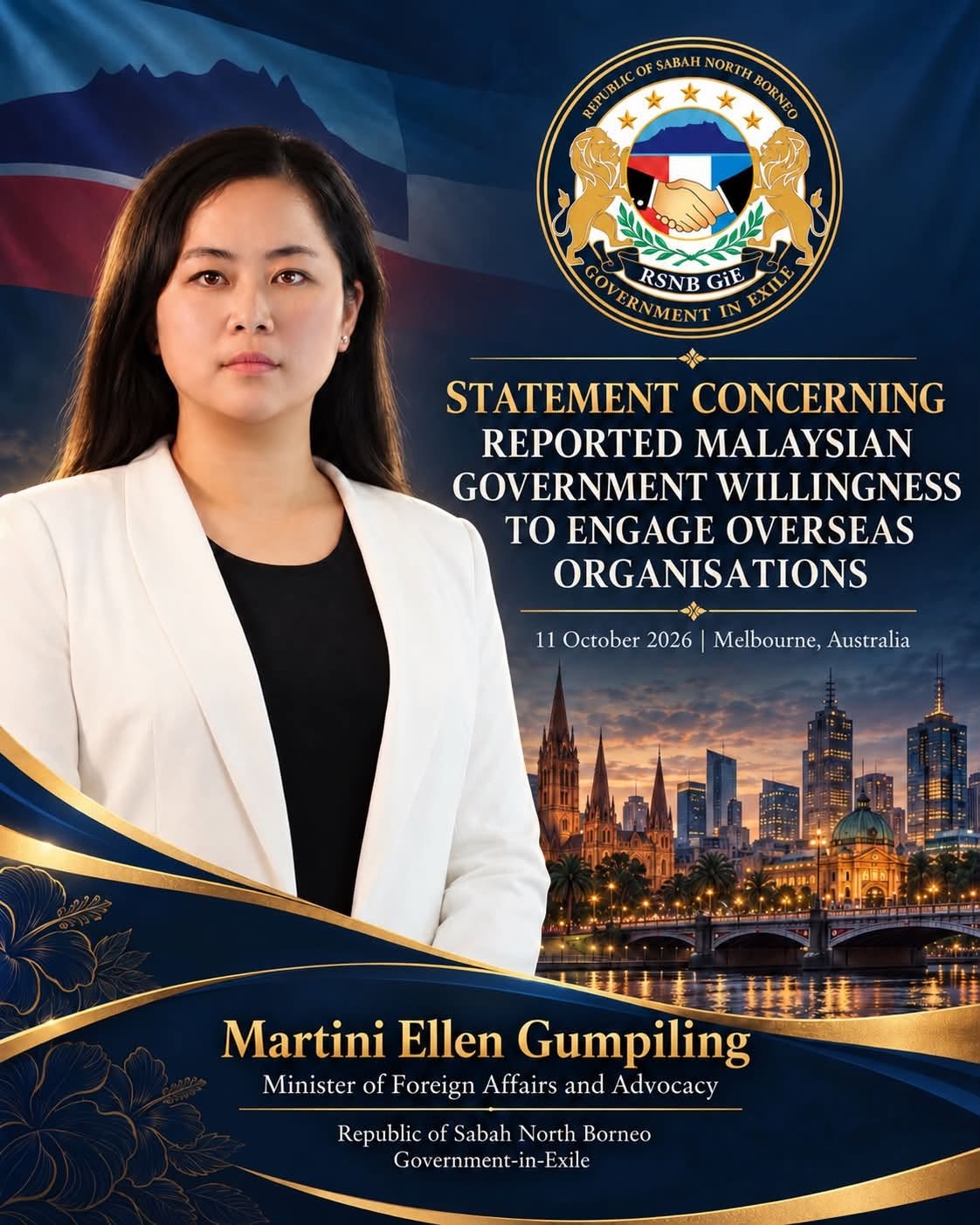 ★ Featured
STATEMENT CONCERNING REPORTED MALAYSIAN GOVERNMENT WILLINGNESS TO ENGAGE OVERSEAS ORGANISATIONS
The Republic of Sabah North Borneo Government-in-Exile (RSNB-GiE) has taken note of media reports dated 10 October 2026 concerning statements by Datuk Mustapha Sakmud,…
Read · 1 min →
STATEMENT OF CONDOLENCES ON THE PASSING OF TUN DR HASMAH MOHAMAD ALI
The Republic of Sabah North Borneo Government-in-Exile (RSNB-GiE) extends its deepest condolences to Tun Dr Mahathir Mohamad, his family, relatives and loved ones following…
Read · 1 min →